Walking on wet, rocky trails presents a unique set of challenges. Whether you are scrambling over damp granite in the Scottish Highlands or navigating slick limestone paths in the Yorkshire Dales, your choice of footwear directly impacts your safety, comfort, and stability. Slippery surfaces, sharp edges, and standing water demand specific features that standard walking shoes cannot provide.
Choosing the right hiking footwear for rocky wet terrain requires balancing grip, ankle support, water protection, and drying speed. This guide breaks down these tradeoffs to help you make an informed decision for your next wet-weather hill walk.
Key takeaways
- Rubber compound matters: Softer rubber compounds provide better grip on wet rock but wear down faster on hard surfaces.
- Waterproof vs. Breathable: Membrane linings keep shallow water out but dry slowly once submerged.
- Lug design: Deep, widely spaced lugs prevent mud buildup, while flat contact patches grip wet slabs.
- Ankle support: Stiff boots protect against twists on uneven scree, while trail shoes offer agility.
Grip and outsole choices on wet rock
Traction is your primary defence against slips on wet rock. The performance of an outsole on wet, uneven surfaces depends on two main factors: the rubber compound and the lug pattern.
Many manufacturers use proprietary rubber, while others rely on third-party specialists like Vibram. For wet rock, a softer, stickier rubber compound (such as Vibram Megagrip or equivalent sticky rubbers) is essential. Softer rubber conforms to the microscopic imperfections of wet stone, creating more friction. The tradeoff is durability; these soles wear down quicker on dry, abrasive tarmac or hard-packed gravel than harder compounds.
Lug depth and spacing also play a critical role. For muddy, wet paths, deep lugs (5mm or more) bite into the ground. However, on flat, wet rock slabs, you need more surface area contact. Look for outsoles that feature a “climbing zone” at the toe – a flat section of rubber without deep lugs – which allows for better grip when stepping onto rocky ledges. Widely spaced lugs are also preferable, as they shed mud naturally rather than packing it in and turning your sole into a slick slide.
Support, flexibility and when each matters
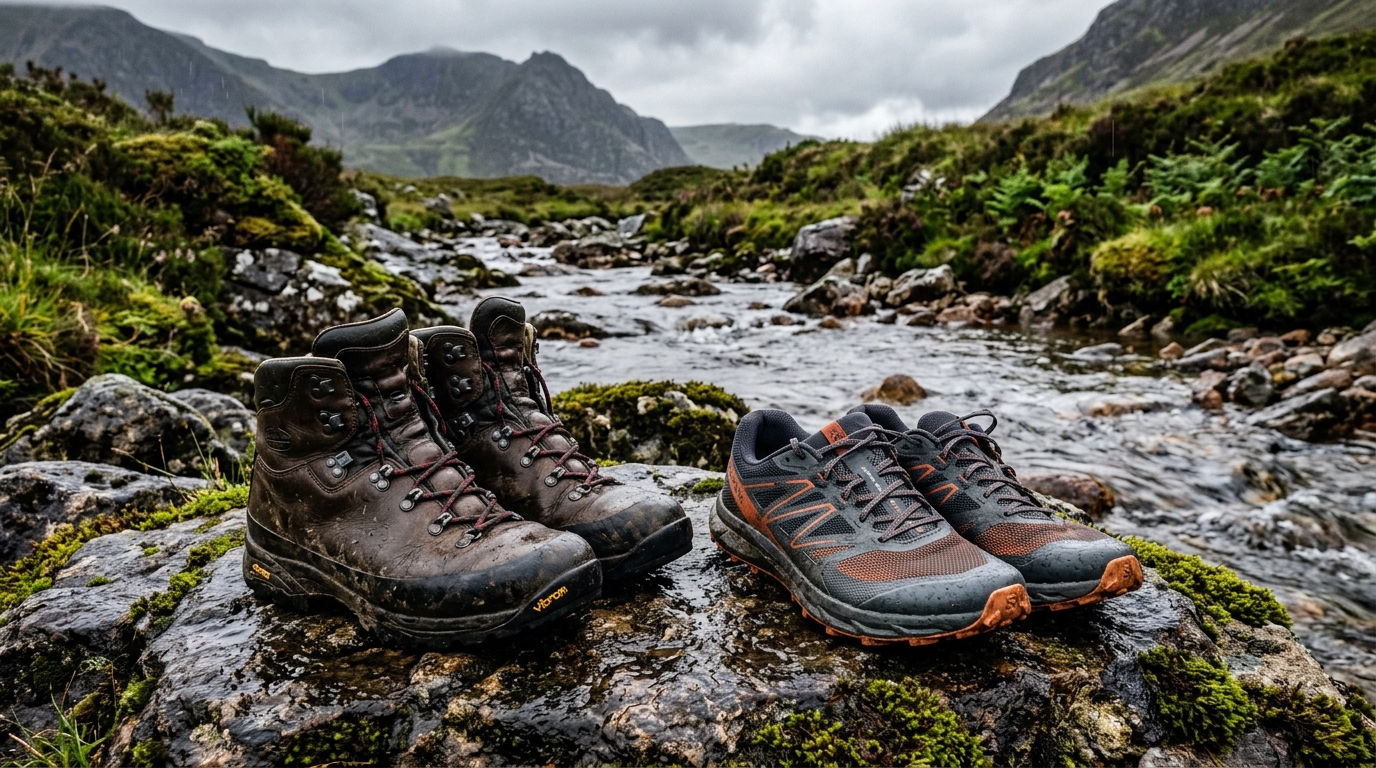
When selecting footwear for uneven ground, you must decide between the ankle support of a traditional boot and the flexibility of a trail running shoe.
High-cut boots offer mechanical support to the ankle joint, which is highly beneficial when carrying a heavy pack or navigating loose scree fields. The stiff midsole of a boot also prevents your foot from wrapping around sharp rocks, reducing foot fatigue over long distances. If you are planning demanding routes with significant elevation changes, this stability is invaluable.
Conversely, low-cut trail shoes allow your ankle to move naturally, which can actually improve balance on uneven ground by letting your body adapt to the terrain. They are significantly lighter, reducing the energy required with every step. However, they offer minimal protection against lateral roll if you misstep on a wet rock. If you choose trail shoes, ensure they have a rock plate – a thin, hard plastic layer inside the sole that protects the bottom of your foot from sharp stone bruises. For more advice on packing light to match lighter footwear, consult our day hike essentials checklist.
Waterproof linings or faster-drying shoes
Keeping your feet dry is a major priority, but how you achieve this depends on the expected conditions.
Waterproof membranes, such as Gore-Tex, are highly effective at keeping out rain, dew, and shallow puddles. They keep your feet warm in cold, damp environments. However, they have a major drawback on wet, rocky routes: if water spills over the collar of the shoe – during a deep stream crossing or in heavy downpours – it becomes trapped. A waterproof boot acts like a bucket, holding water inside and making the footwear heavy and prone to causing blisters.
Fit, protection and late-day comfort
Footwear that feels fine in the shop can become painful after several hours of descending. Try boots or shoes with the socks you actually hike in, leave enough room for toes to spread downhill, and check that your heel does not lift with every step. On rocky wet terrain, a precise fit matters as much as the outsole.
Ankle support is useful when carrying a heavy pack or walking on loose blocks, but it does not replace balance and foot placement. Some walkers move better in lower trail shoes because they can feel the ground and adjust quickly. Others prefer a boot because it reduces fatigue on long, rough descents. The right answer depends on terrain, load and your injury history.
Footwear choices for wet and rocky trails
| Option | Best use | Tradeoff |
|---|---|---|
| Waterproof boot | Cold, boggy routes and heavy packs. | Slow to dry if water gets inside. |
| Non-waterproof trail shoe | Warmer routes, fast drying and lighter loads. | Feet get wet sooner in grass or rain. |
| Approach shoe | Rocky paths, scrambling approaches and sticky slabs. | Less comfortable on long muddy sections. |
| Mid-height hiking shoe | Mixed terrain where you want moderate support. | Can be neither as nimble as a shoe nor as protective as a boot. |
For most walkers, the safest choice is the one you have already tested on shorter local walks before taking it into a long wet route.
Use terrain, weather and timing before the kit decision.